
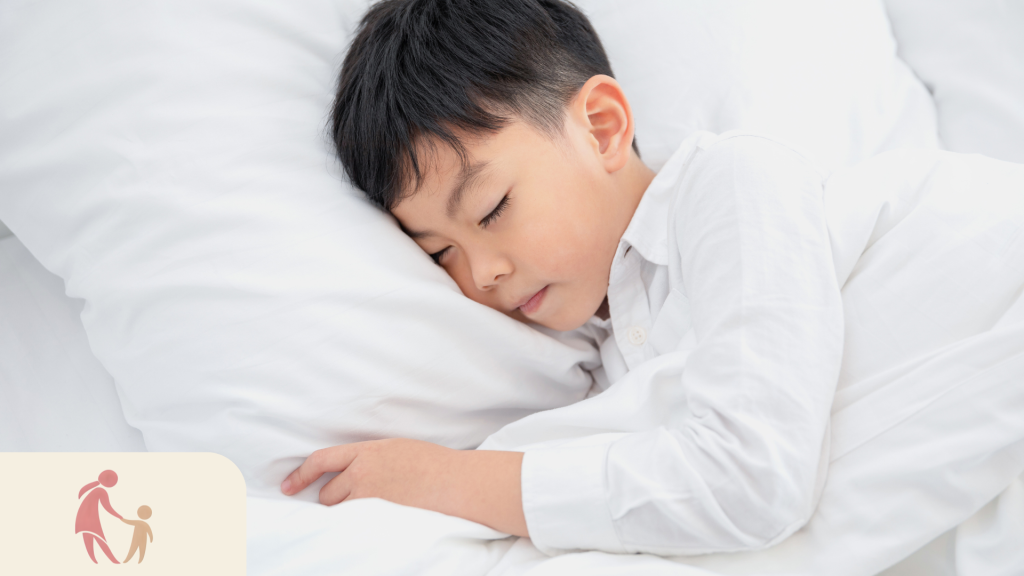
A child who refuses to get out of bed in the morning may simply look tired. Another child may become unusually emotional, restless, distracted, or difficult to settle.
In many cases, parents naturally focus on behaviour first. However, sleep can be part of the picture.
Children need different amounts of sleep as they grow. Babies may spend much of the day sleeping, while school-age children gradually move toward longer periods of uninterrupted night sleep. Teenagers need fewer hours than toddlers, although they still require considerably more sleep than many busy schedules allow.
Understanding Child Sleep Hours by Age can help parents set realistic bedtimes, recognise possible sleep shortfalls, and build routines that support learning, mood, physical development, and everyday wellbeing.
At the same time, recommended sleep hours are ranges rather than exact targets. One child may function well near the lower end, while another may need more. Therefore, the number on the clock matters, but so do sleep quality, consistency, and how your child feels during the day.
Child Sleep Hours by Age: Recommended Daily Sleep
The amount of sleep children need changes significantly during childhood.
The US Centers for Disease Control and Prevention summarises age-based recommendations drawn from major sleep organisations, while the World Health Organization provides similar guidance for children under five. Importantly, the numbers below refer to total sleep across 24 hours, so naps count too.
| Age | Recommended Sleep in 24 Hours |
| Newborn, 0–3 months | 14–17 hours |
| Infant, 4–12 months | 12–16 hours, including naps |
| Toddler, 1–2 years | 11–14 hours, including naps |
| Preschooler, 3–5 years | 10–13 hours, including naps |
| School-age child, 6–12 years | 9–12 hours |
| Teenager, 13–17 years | 8–10 hours |
These ranges are helpful starting points rather than strict rules.
For example, an 8-year-old who sleeps 10 hours and wakes naturally feeling alert may be getting an appropriate amount. Meanwhile, another 8-year-old may need closer to 11 hours to function comfortably throughout the day.
The pattern can also change during growth spurts, illness, stressful periods, travel, or major routine changes.
Why Sleep Needs Change as Children Grow
Sleep is closely tied to development. During infancy, the brain and body are changing rapidly, which is one reason babies spend so much time asleep. Their sleep is also divided into shorter periods across the day and night.
As children grow, sleep becomes more consolidated. Naps gradually decrease, night-time sleep becomes longer, and biological rhythms become more predictable.
Eventually, many preschoolers stop napping altogether. However, less daytime sleep does not mean sleep suddenly becomes unimportant.
School-age children are managing more complex learning, social situations, physical activity, and emotional demands. Teenagers face another shift: their biological sleep timing naturally tends to move later, even though school and daily responsibilities may still require early mornings.
In other words, bedtime changes, but the need for sufficient sleep remains.
Why Getting Enough Sleep Matters
Sleep is not simply a period when children “switch off.”
It supports processes involved in learning, memory, mood, behaviour, growth, physical health, and emotional regulation.
A 2025 systematic review examining children aged 6 to 12 looked at 20 studies published between 2019 and 2024. The researchers found broadly consistent associations between better sleep and stronger cognitive performance, emotional wellbeing, and fewer behavioural difficulties. However, they also noted that many studies were observational, so the findings do not prove that sleep alone caused every outcome.
Earlier evidence points in a similar direction.
A systematic review covering 69 studies and more than 148,000 children aged 0 to 4 found that shorter sleep was generally associated with poorer emotional regulation, higher adiposity, and several other less favourable health outcomes. Still, the strength of evidence varied depending on the outcome.
For children aged 5 to 17, another review covering 592,215 participants across 40 countries found that longer sleep was associated with better emotional regulation, academic achievement, quality of life, and lower adiposity indicators. Again, researchers cautioned that much of the evidence came from observational studies.
So, sleep should not be treated as a magic solution for every behavioural or learning problem. Still, consistently getting too little sleep can make an already demanding day harder.
Signs Your Child May Not Be Getting Enough Sleep
Sleep deprivation does not always look like a sleepy child yawning on the sofa. Children can show tiredness differently. Possible signs include:
- difficulty waking in the morning
- needing repeated reminders to get out of bed
- falling asleep during short car rides
- irritability or frequent emotional outbursts
- difficulty concentrating
- unusually high activity or restlessness
- poor frustration tolerance
- struggling with homework later in the day
- sleeping much longer on weekends
- regularly asking for naps despite usually having outgrown them
Teenagers may also rely heavily on alarms, caffeine, or long weekend sleep-ins to compensate for short weekday sleep.
One sign alone does not prove a sleep problem. However, a repeated pattern can be worth looking at more closely.
Sleep Duration Is Only Part of the Story
A child might technically spend ten hours in bed but still wake feeling tired.
Why?
Because good sleep also depends on quality and timing.
A child whose sleep is repeatedly interrupted may not feel as rested as another child who sleeps for the same length of time without frequent waking. Similarly, irregular sleep times can make the body’s internal rhythm harder to maintain.
Research on sleep timing has linked later sleep patterns in children and adolescents with shorter total sleep, poorer sleep quality, emotional difficulties, and lower academic or cognitive outcomes. However, the researchers rated the overall quality of evidence as very low because most available studies were observational.
Therefore, rather than asking only:
“How many hours did my child sleep?”
It can also help to ask:
- Did they fall asleep reasonably easily?
- Did they wake repeatedly?
- Do they wake feeling refreshed?
- Are their bedtime and wake times fairly consistent?
- Are they alert during the day?
The answers provide a fuller picture.
How Much Sleep Do Babies Need?
Babies have the highest sleep requirements.
Newborns: 0–3 Months
Newborns may sleep around 14 to 17 hours across 24 hours according to WHO and CDC guidance.
However, newborn sleep can be highly irregular.
Sleep may happen in short stretches because feeding, day-night rhythm development, and individual biology all influence the pattern.
Therefore, parents should not expect a newborn to sleep according to an older child’s timetable.
Infants: 4–12 Months
From around four months onward, the recommended range is generally 12 to 16 hours in 24 hours, including naps.
By this stage, some babies begin sleeping for longer periods at night, although night waking remains common.
Naps are still an important part of the total.
How Much Sleep Do Toddlers Need?
Children aged 1 to 2 generally need around 11 to 14 hours per day, including naps. This age can bring new bedtime challenges.
Toddlers are becoming more independent. They may realise that staying awake means more play, more attention, or more time with parents.
As a result, “one more book,” “one more drink,” and “I don’t want to sleep” can quickly become part of the evening. At the same time, many toddlers still need one daytime nap.
A consistent routine can help signal that the day is winding down, even when the child would rather continue playing.
How Much Sleep Do Preschoolers Need?
Children aged 3 to 5 generally need 10 to 13 hours of total sleep per day. Naps may still contribute to the total. This is also the age when nap needs begin to vary significantly.
Some children still sleep for one or two hours during the day. Others stop napping and shift that sleep into the night.
A child who stops napping may temporarily need an earlier bedtime.
Rather than forcing a nap based purely on age, watch your child’s daytime behaviour. If they remain alert and emotionally steady until bedtime, they may be managing well without one.
How Much Sleep Do School-Age Children Need?
Children aged 6 to 12 generally need 9 to 12 hours of sleep per 24 hours. At this stage, sleep can easily get squeezed by:
- homework
- enrichment activities
- sports
- screen time
- family schedules
- early school mornings
- social activities
This creates an important practical issue.
If a child needs to wake at 06:30 and functions best with around 10 hours of sleep, they need to be asleep by roughly 20:30, not simply starting their bedtime routine at that time.
The difference matters.
A 2025 systematic review of school-age children concluded that better sleep was associated with healthier cognitive, emotional, and behavioural outcomes, although the authors cautioned that more longitudinal and experimental research is needed.
How Much Sleep Do Teenagers Need?
Teenagers aged 13 to 17 generally need 8 to 10 hours of sleep per night. That may sound achievable, but adolescence can make sleep complicated.
Teenagers often become naturally sleepy later at night. Meanwhile, school start times may still require early waking.
Add homework, social activities, gaming, streaming, and messaging, and sleep can quickly become the activity that gets sacrificed.
However, sleeping five or six hours on weekdays and trying to recover entirely on weekends does not create the same consistency as getting enough sleep regularly.
Weekend recovery sleep may help with short-term tiredness, but it does not make chronic weekday sleep loss an ideal pattern.
How to Build a Bedtime Routine That Actually Helps
A bedtime routine does not need to be elaborate. In fact, the simpler it is, the easier it may be to repeat. A practical routine might look like:
- Finish energetic play.
- Put away screens.
- Take a bath or shower.
- Brush teeth.
- Change into sleepwear.
- Read or talk quietly.
- Dim the lights.
- Go to bed at roughly the same time.
The important part is predictability. If bedtime changes dramatically every night, children receive mixed signals about when the day is supposed to end. Meanwhile, a repeated sequence can become a behavioural cue for sleep.
Screens Can Quietly Push Bedtime Later
A child saying “five more minutes” can easily turn into another 30 minutes.
Screens may delay sleep simply because they compete with bedtime. Children may also become mentally engaged in games, videos, or conversations just when they need to wind down.
That does not mean every device must disappear from family life. Instead, parents can create a clear stopping point before bed.
For example:
“Tablet time finishes at 7:30. Then we get ready for bed.”
This tends to work better when the rule is predictable rather than negotiated from scratch every night.
Work Backwards From Wake-Up Time
One of the easiest ways to set bedtime is to start with the morning. Suppose your 7-year-old needs to wake at 06:30. If your child generally needs around 10 hours of sleep, work backwards:
06:30 wake-up → around 20:30 asleep
Then allow time before that for the bedtime routine. So the routine might begin at 19:45 or 20:00 rather than 20:30. This approach is more useful than choosing a bedtime simply because it “sounds right.”
Don’t Panic Over One Late Night
Sleep recommendations work best as patterns, not daily scorecards. A birthday party, holiday, family gathering, flight, or special event will sometimes push bedtime later.
That is normal. Problems are more likely to arise when short sleep becomes the routine rather than the exception.
Instead of worrying about one unusual night, look at the week as a whole.
Ask whether your child is generally sleeping within the appropriate range and functioning well during the day.
When Should Parents Speak With a Doctor?
Some sleep difficulties are behavioural and improve with routine changes. Others may need medical attention. Consider speaking with your child’s doctor if your child:
- snores loudly or regularly
- appears to stop breathing during sleep
- gasps or struggles to breathe at night
- is extremely sleepy during the day despite enough time in bed
- frequently wakes with headaches
- has persistent trouble falling or staying asleep
- shows a major change in sleep patterns
- regularly sleeps far outside the recommended range
- has sleep difficulties that interfere with school or family life
The CDC also recommends speaking with a healthcare provider when sleep problems are persistent.
Sleep difficulties can have many causes, so professional evaluation matters when the problem continues despite reasonable routine changes.
Don’t Turn Sleep Into a Competition
It is easy to compare.
“My friend’s child sleeps 12 hours.”
“My niece stopped napping at two.”
“My child wakes earlier than everyone else.”
But healthy sleep is not a parenting competition.
Two children of the same age may have slightly different sleep needs while still falling within a healthy range.
Instead of chasing the longest possible sleep duration, look at the combination of:
age + recommended range + sleep quality + daytime behaviour.
That gives you a much better picture than one number alone.
Final Thoughts
Understanding Child Sleep Hours by Age gives parents a practical starting point, but healthy sleep is about more than reaching a target number every night.
Your child needs enough total sleep, but consistency, bedtime timing, sleep quality, daytime naps, and individual needs matter too.
A preschooler may still need a daytime nap. A school-age child may need an earlier bedtime during busy weeks. A teenager may need more protection from late-night schedules than they realise.
Therefore, use sleep recommendations as a guide rather than a rigid rule. Watch your child.
Are they alert in the morning? Can they concentrate? Do they regularly become exhausted late in the day? Are weekends spent catching up on several hours of lost sleep?
Those patterns can tell you just as much as the clock.
A healthy routine does not require a perfect bedtime every night. What matters most is giving your child regular opportunities to get the sleep their growing body and brain need.