Healthy children are not built from perfect lunchboxes, rigid bedtimes, or a calendar packed with sports.
More often, kids healthy habits grow from small things repeated often: drinking water with meals, getting enough sleep, moving their bodies, brushing their teeth, taking breaks from screens, and having time to talk with the people around them.
Of course, knowing what children should do is usually the easy part. Making it happen on school mornings, busy afternoons, picky-eating days, and tired evenings is another story.
The good news is that healthy routines do not need to change everything at once. In fact, habits are often easier to maintain when families focus on simple behaviours that fit naturally into everyday life.
Research also suggests that health behaviours work together. A systematic review of 141 studies involving children and adolescents found that combinations of higher physical activity, lower sedentary behaviour, and adequate sleep were generally associated with better physical, psychological, and education-related outcomes.
So rather than looking for one “perfect” habit, it makes more sense to build a collection of small ones.
Why Healthy Habits Matter During Childhood
Childhood is when many everyday routines begin taking shape.
Children learn when meals happen, what drinks are normally available, how the family responds to stress, what bedtime looks like, and how much movement fits into an ordinary day.
Importantly, young children learn many of these behaviours by watching rather than listening.
If adults regularly drink water, move their bodies, sit down for meals, put phones away sometimes, and follow a bedtime routine, children repeatedly see those behaviours as normal parts of life.
The World Health Organization also highlights early childhood as a period of rapid physical and cognitive development when lifestyle habits are forming.
However, healthy habits should not become another source of pressure.
The goal is not perfection. Nor should health become focused on a child’s body size or on labelling foods as morally “good” and “bad”.
Instead, healthy routines can support energy, development, concentration, sleep, dental health, emotional wellbeing, and a child’s ability to take part in everyday activities.
8 Kids Healthy Habits Worth Building Early
Healthy routines work best when children can practise them repeatedly. Some will require more support at first, while others gradually become automatic. Here are eight areas parents can work on.
1. Make Balanced Food Feel Normal, Not Special
Healthy eating does not have to mean turning every meal into a nutrition lesson. A simpler approach is to make a variety of foods regularly available.
That can include vegetables, fruits, whole grains, pulses, protein-rich foods, dairy or suitable alternatives, and water.
Current WHO guidance recommends that carbohydrate sources for children aged two and above come primarily from whole grains, vegetables, fruits, and pulses. It also suggests at least 250 g of fruit and vegetables per day for children aged 2–5, 350 g for ages 6–9, and 400 g from age 10 onward.
That does not mean parents need to weigh a preschooler’s vegetables at dinner. Think of the numbers as population-level guidance rather than a daily test. At home, a more practical approach may be:
- regularly offering fruit or vegetables
- including familiar foods alongside less familiar ones
- allowing children repeated exposure to new foods
- eating together when schedules allow
- letting children help wash, prepare, or serve food
- avoiding pressure to clean the plate
Picky eating is particularly common between ages two and four. The American Academy of Pediatrics advises a low-pressure approach, repeated exposure, and family modelling rather than turning meals into a battle.
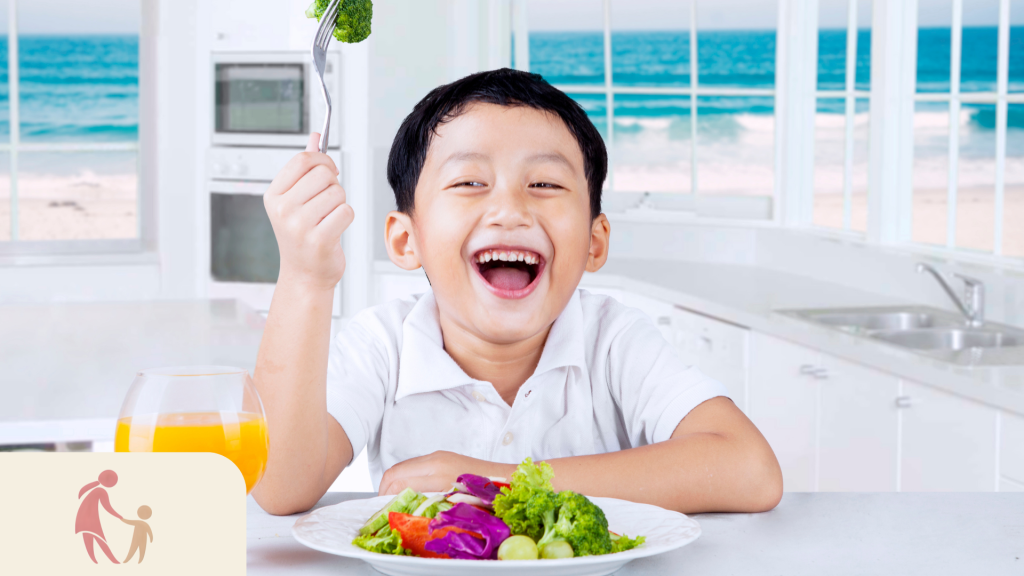
A child may reject broccoli today and eventually accept it after seeing it many more times. That is still part of learning.
2. Make Water the Everyday Drink
Drinks can quietly contribute a significant amount of sugar. Therefore, one of the simplest habits is making water the default drink most of the time.
WHO recommends keeping free sugars below 10% of total daily energy intake and suggests that reducing intake below 5% may provide additional health benefits. Free sugars include sugars added to foods and beverages as well as those found in honey, syrups, fruit juice, and juice concentrates.
This does not mean a child can never have a sweet drink. Instead, think about what happens most days.
Water with ordinary meals and when children are thirsty creates a simple default. Sweet drinks can then remain occasional rather than becoming the drink children expect every time they eat.
3. Give Children Plenty of Time to Move
Children are naturally active when given opportunities. Running around a playground, cycling, swimming, climbing, dancing, kicking a ball, walking, and playing tag all count as movement.
For children aged 5–17, WHO recommends an average of at least 60 minutes of moderate-to-vigorous physical activity per day across the week, mostly aerobic activity.
Younger children need even more opportunities for movement.
WHO guidance recommends at least 180 minutes of varied physical activity spread across the day for children aged one to four, with children aged three to four getting at least 60 minutes of moderate-to-vigorous activity within that total.
Still, exercise does not always need to look like organised sport. For younger children especially, play is exercise. Instead of asking, “Did my child work out today?” a more useful question may be:
“Did my child have enough opportunities to move?”
That could happen through a playground visit, a walk after dinner, active play at home, swimming, sport, or simply running around with friends.
4. Protect Their Sleep Routine
Sleep often gets squeezed when family schedules become busy.
A slightly later bedtime may seem harmless. However, when it happens night after night, children can begin accumulating a sleep shortfall.
According to the CDC, recommended daily sleep ranges are:
| Age | Recommended Sleep |
| 1–2 years | 11–14 hours including naps |
| 3–5 years | 10–13 hours including naps |
| 6–12 years | 9–12 hours |
| 13–17 years | 8–10 hours |
A useful bedtime routine does not need ten steps. It might simply be:
bath → brush teeth → pyjamas → book → lights out.
The sequence matters because repetition helps children know what comes next. Likewise, working backwards from wake-up time can make bedtime more realistic.
If your child needs to wake at 06:30 and usually needs around 10 hours of sleep, they need to be asleep at approximately 20:30—not beginning homework, showering, or getting ready for bed at that time.
5. Create Healthy Boundaries Around Screens
Screens are part of modern childhood. They can support learning, entertainment, creativity, communication, and relaxation. So the goal does not have to be removing them completely.
Instead, pay attention to what screen time is replacing. Does it regularly push bedtime later? Does it replace outdoor play?
Does the family struggle to have a conversation during dinner because everyone is looking at separate devices?
The American Academy of Pediatrics encourages families to build a media plan and create screen-free times and places, including meals and bedtime. One practical way to think about media use is to protect a few parts of the day first.
For example:
Meals stay screen-free.
Devices stop before bedtime.
Homework comes before recreational screens.
Outdoor or active play still has a place in the day.
This approach shifts the conversation away from constantly counting minutes and toward maintaining balance.
There is also growing research behind looking at movement, sedentary time, and sleep together rather than treating each behaviour separately.
A 2025 systematic review and meta-analysis involving 19 studies and 11,826 young people found that relatively more moderate-to-vigorous physical activity and sleep, alongside less sedentary time, were associated with better social-emotional health, although effect sizes were generally small.
6. Teach Hygiene Until It Becomes Automatic
Healthy habits also include the less glamorous routines. Washing hands. Brushing teeth. Covering coughs. Bathing. Changing dirty clothes. For younger children, these behaviours need repetition before they become automatic. Handwashing is one good example.
The CDC recommends teaching children five basic steps—wet, lather, scrub, rinse, and dry and building handwashing into predictable moments such as before eating, after using the bathroom, after outdoor play, and after coughing or sneezing.
Dental hygiene deserves the same consistency. The CDC recommends that children brush twice daily with fluoride toothpaste, with parents helping or supervising while children are still developing reliable brushing skills.
Rather than repeatedly asking:
“Did you brush your teeth?”
Attach brushing to something that already happens.
For example:
Breakfast finishes → brush teeth.
Bedtime story finishes → brush teeth.
When the cue stays consistent, the behaviour gradually requires less negotiation.
7. Give Children Space to Talk About How They Feel
Health is not only physical.
Children also need opportunities to understand stress, disappointment, anger, excitement, fear, and frustration.
You do not need a formal emotional wellbeing lesson every evening.
Sometimes it begins with one question:
“What was hard about today?”
Or:
“What was the best part?”
Family meals can offer one natural setting for these conversations.
The American Academy of Pediatrics notes that shared meals can support communication and are associated with healthier eating patterns and several measures of family and mental wellbeing.
Of course, eating together every night may not fit every family’s schedule.
Breakfast on weekends counts.
A quick meal together after an activity counts.
Even ten minutes of undistracted conversation can create space for children to share what is going on in their lives.
The important part is not creating a perfect family dinner scene.
It is making connection part of the routine.
8. Teach Rest as Well as Productivity
Children’s schedules can become surprisingly full.
School.
Homework.
Tuition.
Sports.
Music.
Enrichment classes.
Birthday parties.
Family commitments.
Many of these activities can be positive. However, children also need unstructured time.
A quiet afternoon does not need to be “filled”.
Free play gives younger children room to imagine, negotiate, explore, and solve problems. Older children may need downtime simply to read, draw, talk, listen to music, or do nothing particularly productive.
Rest should not become something children think they have to earn after being busy enough.
Instead, it is part of a balanced routine.
Don’t Try to Change Everything This Week
Parents often make healthy changes with good intentions and then create six new rules at once.
No sweets.
Earlier bedtime.
Daily exercise.
Less screen time.
More vegetables.
More water.
Suddenly, every part of the day feels like a correction.
Instead, pick one habit.
Suppose evenings feel chaotic.
Start with bedtime.
For two weeks, focus on getting the routine predictable.
Once that feels normal, perhaps move on to screens before bed.
Then work on breakfast.
Healthy routines become much easier when children have time to adjust.
Make the Healthy Choice the Easy Choice
Willpower is difficult for adults, let alone children.
So change the environment.
If you want children to drink more water, put water within reach.
If you want fruit to become an easy snack, prepare it before children are hungry.
If devices keep delaying bedtime, charge them outside the bedroom.
If your child needs more movement, keep a ball, bicycle, skipping rope, or other active toys accessible.
If mornings are rushed, prepare school bags the night before.
Small environmental changes can reduce the number of decisions everyone has to make.
Your Habits Matter Too
Children notice contradictions very quickly.
It is hard to explain why phones are banned from dinner while an adult is answering messages beside the plate.
Likewise, telling children to try vegetables works differently when adults never eat them.
Parents do not need perfect habits.
Instead, let children see you practise.
You can say:
“I’ve been sitting for ages. I’m going for a short walk.”
Or:
“I need to put my phone away because I’m getting ready for sleep.”
Or:
“I’ve never tried this vegetable either. Let’s see what it’s like.”
The AAP also encourages parents to act as role models by making healthy eating and daily activity normal parts of family life.
Children learn from what happens around them repeatedly.
What Healthy Habits Should Not Become
Healthy routines should support children, not make them anxious about health.
Avoid turning ordinary food choices into guilt.
Likewise, exercise should not become punishment for eating, and children should not be taught that body size determines whether someone is healthy or unhealthy.
Instead, talk about what habits help the body do.
Food gives us energy and nutrients.
Sleep helps us feel rested.
Movement helps our bodies become stronger and builds skills.
Brushing protects our teeth.
Rest helps us recover.
This language keeps the focus on health and function rather than appearance.
When Parents May Need Professional Guidance
Every child is different.
Some children have medical conditions, feeding difficulties, developmental needs, food allergies, sleep disorders, sensory differences, or other factors that make general advice less useful.
Consider talking with a pediatrician or another qualified health professional if your child has ongoing problems such as poor growth, major appetite changes, persistent sleep difficulties, extreme fatigue, frequent pain, difficulty eating a range of foods, or behaviours that substantially affect everyday life.
General healthy-habit advice is useful, but it cannot replace individual medical assessment.
Final Thoughts
Building kids healthy habits is less about creating a perfect routine and more about making helpful behaviours easy to repeat.
Serve a variety of food. Make water readily available. Give children time to move. Protect their sleep. Create sensible boundaries around screens.
Teach hygiene. Make room for conversation. Leave space for rest. Some days will go well. Other days will include takeaway dinner, later bedtimes, missed exercise, or more screen time than planned.
That does not undo the routine. Health grows from patterns over time. So instead of asking whether your family followed every healthy rule today, ask a simpler question:
“What is one small habit we can make easier tomorrow?”
Repeat that often enough, and healthy choices gradually stop feeling like extra tasks. They simply become part of everyday family life.