Child development is not a race. Some children speak earlier, some walk earlier, some are naturally sociable, while others need more time before they feel comfortable joining a group. Because of this, many parents wonder: Is my child developing well?
The reassuring answer is that healthy development is not measured by one perfect checklist. Instead, it is seen through a pattern of growth across different areas: how a child moves, communicates, plays, solves problems, manages emotions, builds relationships, and becomes more independent over time.
According to the CDC, developmental milestones are things most children can do by a certain age, and they offer useful clues about how a child plays, learns, speaks, acts, and moves. However, milestones are not meant to label children harshly. They are better used as a guide to observe progress and seek support early when needed.
In the early years, children’s brains are especially responsive to experience. UNICEF notes that more than one million neural connections are formed every second in the first few years of life, making early childhood a critical period for learning, behaviour, and long-term well-being.
Therefore, when parents understand the signs of healthy child development, they can respond with more confidence. They can celebrate progress, provide the right kind of stimulation, and notice when a child may need extra guidance.
Understanding Healthy Child Development Beyond Milestones
Healthy child development is holistic. It includes physical growth, language development, cognitive ability, emotional regulation, social confidence, and everyday independence. These areas are connected. For example, a child who feels emotionally safe is often more willing to explore. A child who plays often may also develop stronger language, problem-solving, and social skills.
NAEYC explains that all domains of child development, physical, cognitive, social-emotional, and linguistic development are important and support one another. This means parents should avoid looking at only one area, such as reading ability or academic performance, when trying to understand a child’s overall development.
A child may be strong in one area and still developing in another. For instance, a preschooler may speak fluently but still struggle to share toys. Another child may be physically active and independent but need more time to express feelings in words. Both patterns can still be part of normal growth, especially when progress continues over time.
The key is to observe whether the child is gradually becoming more capable, curious, connected, and confident.
Early Learning Readiness and Curiosity
One of the clearest signs of healthy development is curiosity. A developing child naturally wants to explore the world. This may appear as asking many questions, touching objects, repeating activities, pretending, experimenting, or wanting to know how things work.
Curiosity is not just “cute behaviour.” It is a foundation for learning. When a child asks “why,” builds with blocks, mixes colours, listens to stories, or tries to solve a simple puzzle, the brain is actively forming connections.
UNICEF highlights that children’s brains are built through interaction with their environments, and the quality of early experiences can create either strong or weak foundations for future learning, health, and behaviour.
Everyday Signs of Cognitive Growth
Parents may notice healthy cognitive development when a child:
- Tries to solve simple problems before asking for help
- Shows interest in stories, songs, numbers, shapes, or patterns
- Remembers routines, people, and familiar places
- Uses imagination during pretend play
- Sorts, compares, stacks, matches, or classifies objects
- Asks questions and tries to make sense of answers
However, cognitive growth does not need to look academic. A child arranging toy animals by size, pretending a spoon is a microphone, or figuring out how to zip a bag is also developing thinking skills.
In other words, learning happens through daily life, not only through formal lessons.
Language and Communication Progress
Language development is another important sign of healthy child development. This includes more than vocabulary. It also involves listening, understanding instructions, expressing needs, taking turns in conversation, using gestures, and responding to social cues.
A young child may first communicate through eye contact, pointing, sounds, facial expressions, and gestures. Later, this develops into words, short phrases, storytelling, questioning, and conversation.
The CDC emphasizes that how a child speaks and learns offers important clues about development, especially from birth to age five.
Positive Communication Signs Parents Can Observe
Healthy communication may look like:
- Responding when called by name
- Pointing or gesturing to show interest
- Trying to name familiar people, objects, or actions
- Following simple instructions
- Asking questions
- Using words to express feelings or needs
- Enjoying songs, rhymes, books, and conversations
- Taking turns while speaking or playing
As children grow older, parents may notice more complex communication. They may explain what happened at school, tell imaginative stories, negotiate during play, or express opinions.
Still, every child’s language journey can look slightly different. Some children are naturally talkative. Others observe quietly before speaking more. What matters most is steady progress and meaningful interaction.
Social Confidence and Relationship Building
A healthy child does not need to be the loudest child in the room. Social development is not the same as being extroverted. Instead, it is about gradually learning how to connect with others, respond to people, share attention, cooperate, and feel secure in relationships.
The WHO states that early childhood development is shaped by healthy, nurturing interactions between caregivers and children. Responsive caregiving and early learning are central to supporting development.
This means relationships are not separate from development. They are part of development.
Signs of Healthy Social Development
Parents may notice that their child:
- Smiles, laughs, or responds warmly to familiar people
- Looks for comfort from trusted adults
- Shows interest in other children
- Begins to take turns during play
- Imitates adults or peers
- Shows empathy, such as noticing when someone is sad
- Enjoys group activities, even if they sometimes prefer solo play
- Learns simple social rules, such as waiting or saying thank you
For preschool-age children, social growth often happens through play. They learn to negotiate roles, handle disappointment, solve small conflicts, and understand that other people have thoughts and feelings too.
Of course, children will still argue, cry, refuse to share, or become frustrated. That is normal. Healthy development does not mean perfect behaviour. Rather, it means the child is slowly learning social skills with guidance.
Emotional Regulation and Resilience
Emotional development is one of the most important areas parents should observe. A healthy child feels a wide range of emotions: joy, anger, fear, jealousy, excitement, sadness, and frustration. The goal is not to stop big emotions. The goal is to help children understand and manage them over time.
A toddler may cry intensely when a toy is taken away. A preschooler may stomp when they lose a game. A school-age child may feel disappointed when a friend does not want to play. These moments are not automatically signs of poor development. Instead, they are opportunities to learn emotional regulation.
Healthy Emotional Development Looks Like Progress
Signs of emotional growth may include:
- Seeking comfort from a trusted adult
- Naming basic feelings such as happy, sad, angry, or scared
- Recovering from disappointment with support
- Beginning to use words instead of hitting or screaming
- Showing pride after completing a task
- Trying again after making a mistake
- Understanding simple boundaries and routines
Over time, children should become better at calming down, expressing themselves, and adapting to change. However, they still need co-regulation. This means adults help them calm down first, before expecting them to manage emotions independently.
Harvard’s Center on the Developing Child often describes healthy development as being shaped by responsive interactions between children and adults, sometimes called “serve and return.” When adults respond warmly to a child’s sounds, gestures, and needs, they help build the child’s brain architecture and emotional security.
Therefore, emotional regulation begins with connection, not punishment.
Physical Growth, Movement, and Body Confidence
Physical development includes both gross motor and fine motor skills. Gross motor skills involve large movements such as crawling, walking, running, jumping, climbing, and balancing. Fine motor skills involve smaller movements such as holding crayons, using utensils, turning pages, stacking blocks, buttoning clothes, or manipulating puzzle pieces.
Healthy physical development can be seen when a child gradually gains better control over the body. They become more coordinated, more confident, and more willing to try new movements.
Movement-Based Signs of Healthy Development
Depending on age, parents may observe:
- Improved balance and coordination
- Interest in climbing, running, dancing, or outdoor play
- Better hand-eye coordination
- Ability to feed themselves with increasing control
- Drawing lines, shapes, or simple pictures
- Building with blocks or small toys
- Dressing with less help over time
- Showing stamina during active play
Movement also supports other parts of development. For example, outdoor play can strengthen confidence, social interaction, problem-solving, and emotional regulation.
This is why healthy development should not be limited to sitting, worksheets, or structured academic tasks. Children need time to move, explore, and use their bodies.
Play as a Powerful Developmental Signal
Play is one of the strongest signs of healthy child development. Through play, children practise language, imagination, problem-solving, movement, emotional expression, and social skills.
The American Academy of Pediatrics states that play contributes to children’s cognitive, physical, social, and emotional well-being. More recent AAP guidance also describes play as important for supporting healthy development, nurturing relationships, and reducing toxic stress.
This means play is not a break from learning. Play is learning.
Types of Play That Show Development
Different kinds of play reveal different strengths:
Pretend Play and Imagination
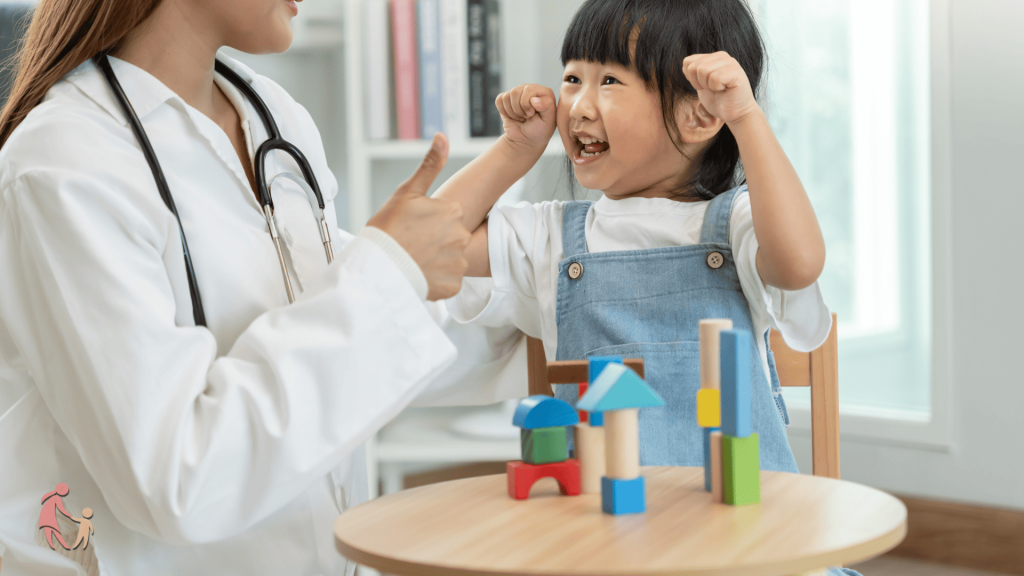
When children pretend to cook, become a doctor, run a shop, care for a doll, or create imaginary worlds, they are developing symbolic thinking. They are learning that one object can represent another and that stories can have roles, rules, and emotions.
Constructive Play and Problem-Solving
Building towers, making tracks, completing puzzles, or creating artwork helps children practise planning, trial and error, patience, and spatial awareness.
Social Play and Cooperation
Playing with others teaches turn-taking, negotiation, empathy, leadership, and flexibility. Even small conflicts during play can become useful learning moments when adults guide children calmly.
Physical Play and Confidence
Running, jumping, balancing, and climbing help children build strength and coordination. In addition, physical play supports confidence because children learn what their bodies can do.
A child who plays actively, imaginatively, and socially is often showing healthy development across several domains at once.
Independence in Everyday Routines
Another sign of healthy child development is growing independence. Children naturally begin to want to do things by themselves: eating, choosing clothes, washing hands, packing toys, opening containers, or helping with simple household tasks.
This independence can sometimes feel inconvenient for adults because children may take longer or make a mess. However, these moments are valuable. They build confidence, responsibility, motor skills, decision-making, and self-esteem.
Practical Signs of Growing Independence
Parents may see progress when a child:
- Tries to feed or dress themselves
- Helps clean up toys
- Makes simple choices
- Follows familiar routines
- Takes care of personal items
- Attempts tasks before asking for help
- Shows pride in “I did it myself” moments
Importantly, independence should be supported gradually. Children still need safety, structure, and encouragement. The goal is not to rush them into maturity, but to give them enough space to practise.
Healthy Sleep, Energy, and Daily Rhythm
Sleep is closely linked to development. A child who sleeps well is often better able to focus, regulate emotions, remember what they learn, and participate in daily activities.
The American Academy of Sleep Medicine consensus statement recommends 10–13 hours of sleep per 24 hours for children aged 3–5 years and 9–12 hours for children aged 6–12 years to support optimal health.
Meanwhile, the AAP advises keeping screens out of children’s bedrooms at night and turning off screens at least one hour before bedtime to prevent sleep disruption.
Signs of a Healthy Daily Rhythm
A child may be showing healthy development when they:
- Has enough energy for play and learning
- Can settle into predictable routines
- Recovers well after rest
- Eats with a generally stable appetite
- Participates in daily activities without constant exhaustion
- Shows mood improvement after proper sleep
Of course, occasional sleep disruptions are normal, especially during illness, transitions, travel, or developmental changes. However, long-term sleep difficulties may affect behaviour and learning, so parents should pay attention to patterns.
Positive Learning Attitude and Confidence
Healthy development also includes a child’s approach to learning. A thriving child does not always get things right immediately. Instead, they show willingness to try, make mistakes, ask for help, and try again.
This is sometimes more important than early academic achievement. A child who is curious, persistent, and confident is building the mindset needed for lifelong learning.
OECD research on early learning highlights that cognitive and social-emotional skills developed in the early years can have long-lasting impacts on later schooling and adult outcomes.
Signs of a Strong Learning Disposition
Parents may notice that their child:
- Shows interest in new activities
- Concentrates for increasing periods
- Tries again after difficulty
- Enjoys books, stories, music, art, movement, or discovery
- Asks for help when needed
- Celebrates small achievements
- Learns from routines and repetition
A child does not need to be “advanced” to be developing well. In fact, healthy learning often looks like engagement, not performance.
When Parents Should Pay Closer Attention
While children develop at different speeds, some signs may suggest that a child needs extra support. Parents should avoid panic, but they should also avoid ignoring repeated concerns.
The CDC encourages parents to track development and act early if they have concerns. Early support can make a meaningful difference because children’s brains are highly responsive during the early years.
Possible Reasons to Seek Guidance
Parents may consider speaking with a paediatrician, child development specialist, or early childhood educator if a child:
- Loses skills they previously had
- Rarely responds to name or familiar voices
- Shows very limited eye contact or social response
- Has ongoing difficulty communicating needs
- Struggles significantly with movement or coordination
- Shows extreme difficulty calming down across many situations
- Avoids interaction consistently
- Has feeding, sleep, or behaviour challenges that affect daily life
- Does not show gradual progress over time
Seeking guidance does not mean something is “wrong” with the child. It simply means the child may benefit from additional understanding, assessment, or support.