
Confidence is not about being the loudest child in the room, always volunteering first, or winning every competition.
For children, real confidence often looks quieter. It is the willingness to try a new task, raise a hand despite feeling nervous, ask for help, share an idea, recover after a mistake, or say, “I’ll try again.”
That kind of confidence rarely comes from praise alone. It grows when children feel safe, valued, capable, and trusted to practise skills over time. In other words, children build self-belief through real experiences: making choices, contributing at home, solving problems, learning from setbacks, and seeing their progress.
This is why confidence-building activities for kids do not need to be expensive, complicated, or competitive. A child can gain confidence while helping set the table, completing a simple obstacle course, presenting a drawing, joining a cooperative game, or trying something they once found difficult.
This guide shares practical activities that parents can use at home, outdoors, and in everyday family routines. It also explains how to encourage confidence without putting pressure on children to perform.
Editorial note: This article is based on guidance from the American Academy of Pediatrics, Singapore HealthHub, ECDA, Harvard University’s Center on the Developing Child, and child-development research. It is intended for general parenting education and does not replace individual advice from a paediatrician, psychologist, or child-development professional.
What Healthy Confidence Looks Like in Childhood
Confidence and self-esteem are closely related, but they are not exactly the same.
Confidence is often connected to a child’s belief that they can attempt or learn a specific task. Self-esteem is broader: it is about how children value and accept themselves, including when they make mistakes or are still learning.
A confident child may still feel shy in new settings. They may need encouragement before joining a group, speaking in front of others, or trying a difficult activity. The important difference is that they gradually learn they can handle discomfort, make progress, and ask for support when needed.
Singapore HealthHub explains that healthy self-esteem can help children recognise their strengths, cope with challenges, and develop a more positive outlook. It also advises parents to avoid harmful labels, keep expectations realistic, recognise effort, and encourage age-appropriate independence.
Why Real Experiences Build Self-Belief Better Than Empty Praise
Telling a child, “You are amazing,” may feel encouraging. However, confidence becomes stronger when children can connect encouragement to something real.
For example:
- “You kept trying even when the puzzle was difficult.”
- “You remembered to pack your water bottle.”
- “You were nervous, but you still said hello.”
- “You found another way when your tower fell down.”
Specific feedback helps children notice effort, strategies, and progress. The American Academy of Pediatrics recommends recognising effort and improvement, giving children meaningful ways to contribute, offering age-appropriate choices, and helping them see mistakes as part of learning.
Harvard’s Center on the Developing Child also notes that children’s motivation is supported through curiosity, active play, social interaction, and opportunities to explore rather than through passive learning alone.
Confidence Building Activities for Kids to Try at Home
The following activities are designed to feel achievable rather than overwhelming. Start with one or two that fit your child’s age, interests, and current comfort level.
1. Create an “I Can Help” Routine
Giving children small responsibilities sends an important message: You are a valued part of this family.
For toddlers, this may mean putting toys into a basket or placing napkins on the table. Preschoolers may enjoy feeding a pet with supervision, sorting laundry, or watering plants. Older children can help prepare snacks, pack school items, or take responsibility for a simple household task.
The goal is not perfection. It is contribution.
The American Academy of Pediatrics notes that age-appropriate chores can build life skills, cooperation, responsibility, and self-esteem when adults focus on effort rather than flawless results.
2. Build a Small Skill Ladder
Choose one skill your child wants to improve, then break it into manageable steps.
For example, instead of saying, “Learn to ride a bicycle,” create a small ladder:
- Sit on the bicycle.
- Push with both feet.
- Balance for three seconds.
- Pedal with help.
- Ride a short distance.
Each step becomes a visible success. Children are more likely to persist when a challenge feels possible rather than too big.
This works for swimming, reading aloud, drawing, tying shoelaces, using chopsticks, practising a dance move, or learning a new sport.
3. Set Up a Mini Obstacle Course
Use cushions, masking tape, chairs, soft balls, and safe household items to create an indoor or outdoor obstacle course.
Children can crawl under a table, balance along a taped line, throw a ball into a basket, hop between cushions, or carry an item from one point to another.
Movement gives children a direct sense of what their bodies can do. A 2015 meta-analysis covering 25 randomised controlled trials and 13 non-randomised studies involving 2,991 participants found that supervised physical-activity interventions were associated with small positive improvements in children’s general self-perceptions, self-concept, and self-worth.
Keep the activity playful. Instead of timing every attempt, let children improve against their own previous effort.
4. Try the “Teach Me” Challenge
Ask your child to teach you something they know.
It could be how to build a block tower, draw a cat, play a game, make a paper plane, organise toy cars, or perform a dance move.
Children often gain confidence when adults genuinely listen to their ideas. Let them give instructions, make corrections, and show their expertise.
You can say:
“You know how to do this better than I do. Can you teach me?”
This activity is especially useful for children who may not always feel confident in academic settings but have strong practical, creative, or imaginative skills.
5. Create a Strengths Collage
Provide paper, magazines, printed photos, stickers, crayons, and scissors suitable for your child’s age.
Invite your child to make a collage titled:
“Things I Am Learning to Do”
or
“Things That Make Me Me”
They can include drawings or pictures of favourite activities, family members, pets, hobbies, places, and positive qualities.
Avoid making this an exercise in boasting. Instead, frame it as noticing strengths, interests, and effort.
HealthHub recommends helping children identify their own likes, dislikes, interests, and positive qualities rather than encouraging them to compare themselves with others.
6. Give Your Child Two Meaningful Choices
Confidence grows when children feel that their voice matters.
Offer limited, realistic choices:
- “Would you like to wear the green shirt or the yellow shirt?”
- “Do you want to read before bath time or after?”
- “Would you like apples or bananas for snack?”
- “Should we walk to the playground or ride the scooter?”
- “Would you like to draw or build something today?”
The adult still provides structure. However, the child learns that they can make decisions and handle the outcomes.
ECDA notes that giving children age-appropriate choices can help them feel more in control and reduce anxiety, particularly during new routines such as preschool transitions.
7. Role-Play Brave Everyday Moments
Role-play can make unfamiliar situations feel less intimidating.
Use dolls, toy figures, or simple pretend play to practise moments such as:
- Saying hello to a new classmate
- Asking a teacher for help
- Ordering food politely
- Joining a group game
- Speaking during show-and-tell
- Saying goodbye at preschool drop-off
Take turns being the child, parent, teacher, or friend. Keep the tone light and playful.
ECDA recommends role-playing preschool routines and social situations to help children become more familiar with new experiences and connect learning with fun.
8. Make a “Mistakes Are Part of Learning” Game
Children can become afraid of trying when they believe mistakes are embarrassing or permanent.
Create a simple family habit: whenever someone makes a mistake, ask:
- “What happened?”
- “What did we learn?”
- “What could we try next?”
You can model this yourself.
“I burnt the toast because I forgot the timer. Next time, I will set an alarm.”
This teaches children that mistakes are information, not proof that they are incapable.
Both the American Academy of Pediatrics and HealthHub recommend helping children understand that setbacks are a normal part of learning and that effort, reflection, and trying again can strengthen self-belief.
9. Let Them Lead a Family Activity
Once a week, let your child lead a short family activity.
They could choose a game, explain the rules, select a song, pick a story, lead a stretch routine, or organise a small treasure hunt.
For younger children, leadership may simply mean choosing the bedtime story. For older children, it could involve planning a family game night or helping prepare a weekend snack.
Leadership does not have to mean being in charge of everyone. It can mean learning to express ideas, make decisions, and see that others value their contribution.
10. Use Open-Ended Art Instead of “Perfect” Crafts
Art can help children build confidence because there is often more than one right answer.
Rather than giving step-by-step instructions to make an identical craft, offer materials such as paper, crayons, paint, recycled boxes, clay, fabric, or stickers and ask:
- “What would you like to make?”
- “Tell me about your idea.”
- “What could this become?”
- “What part are you most proud of?”
Open-ended creative activities give children opportunities to make decisions, solve small problems, and express themselves without being judged against a fixed result. Modern Parents’ guide to art enrichment highlights that creative learning can support expression, imagination, fine-motor development, problem-solving, and confidence.
11. Start a Kindness Mission
Confidence is not only about personal achievement. Children can also feel capable when they make a positive difference for someone else.
Create simple “kindness missions,” such as:
- Draw a card for a grandparent
- Help a sibling find a missing item
- Water a neighbour’s plant with permission
- Share a toy during a playdate
- Thank a teacher or caregiver
- Help prepare a snack for the family
The message is not, “Be kind so people praise you.” Instead, it is, “Your actions can matter to other people.”
The American Academy of Pediatrics notes that helping children contribute to others and to their community can strengthen belonging, appreciation, and a sense of personal worth.
12. Play Cooperative Games
Not every confidence-building activity needs a winner.
Try activities where family members work together:
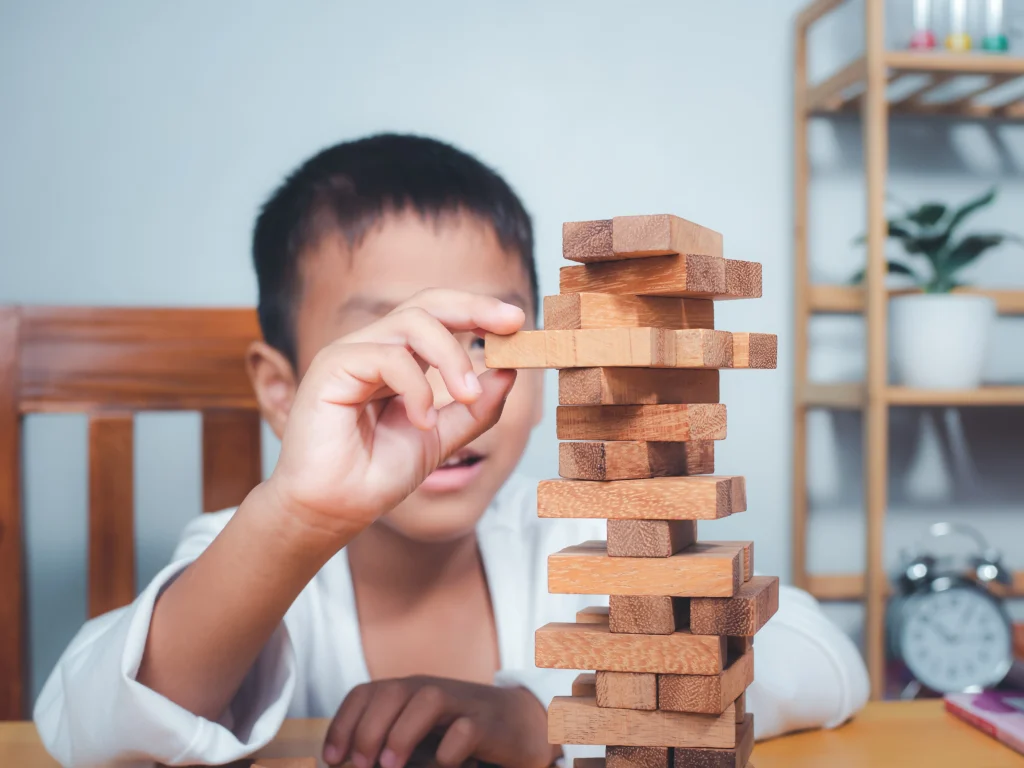
- Build the tallest block tower together
- Complete a puzzle as a team
- Make up a story one sentence at a time
- Create a scavenger hunt
- Work together to build a blanket fort
- Finish a relay challenge as a family
- Cook a simple meal together
Cooperative play helps children practise communication, flexibility, turn-taking, and problem-solving. It can also be a better fit for children who feel discouraged by highly competitive games.
13. Make a “Proud of My Progress” Jar
Keep a jar and small slips of paper in an accessible place.
When your child shows effort, courage, kindness, or persistence, write it down together.
Examples:
- “I tried the monkey bars.”
- “I asked for help.”
- “I put my toys away.”
- “I practised reading even when I got stuck.”
- “I said sorry after I made a mistake.”
At the end of the week, read a few notes aloud. This helps children notice growth that may otherwise be forgotten.
Focus on behaviour and effort, not labels such as “smartest,” “best,” or “perfect.”
14. Encourage a Small “Show and Share” Moment
Some children enjoy performing, while others may find it intimidating. Therefore, keep the audience small and optional.
A child might:
- Show a drawing to one family member
- Explain a Lego creation
- Demonstrate a new skill
- Tell a short story
- Share one thing they learned at preschool
- Present a favourite object during dinner
The aim is not to force public speaking. It is to give children low-pressure chances to use their voice and feel heard.
Start with a safe audience, then allow confidence to grow gradually.
15. Make Time for a Weekly Reflection
At the end of the week, ask three simple questions:
- What was something you enjoyed?
- What was something difficult?
- What is one thing you would like to try again?
Parents can answer too. This normalises the idea that everyone has challenges, learns through practice, and keeps growing.
HealthHub encourages parents to model calm problem-solving, acknowledge children’s positive choices, and help them see challenges as opportunities to learn.
How Parents Can Encourage Confidence Without Creating Pressure
Children need support, but they also need room to try independently.
A helpful balance looks like this:
- Offer help, but do not take over immediately.
- Give choices, but keep boundaries clear.
- Praise effort, but avoid exaggerated praise for everything.
- Let children make small mistakes safely.
- Set goals that are challenging but realistic.
- Avoid comparing siblings, classmates, or friends.
- Focus on progress rather than being “the best.”
HealthyChildren.org advises parents to help children contribute, make age-appropriate decisions, receive specific encouragement, and learn from mistakes without feeling defeated.
Confidence Activities by Age Group
Toddlers: “I Can Do It” Moments
Toddlers build confidence through movement, predictable routines, and simple independence.
Try:
- Putting toys into a basket
- Choosing between two outfits
- Carrying a small bag
- Helping stir ingredients
- Completing a short obstacle course
- Singing action songs
- Naming feelings with picture cards
Keep expectations small. Toddlers gain confidence by doing everyday tasks repeatedly, not by completing long activities.
Preschoolers: Practice, Play, and Social Courage
Preschoolers are ready for more pretend play, simple responsibilities, and opportunities to make decisions.
Try:
- Role-playing school routines
- Helping set the table
- Making a strengths collage
- Playing cooperative board games
- Leading a family song
- Joining beginner art, movement, or sports activities
- Sharing a drawing or short story
ECDA highlights that self-help skills such as dressing, eating, and toileting independently can build confidence and preschool readiness.
Primary School Children: Interests, Responsibility, and Resilience
Older children may benefit from activities that help them build skills over time.
Try:
- Learning a sport, instrument, or creative skill
- Completing a longer project
- Managing a weekly household responsibility
- Joining a club or enrichment programme
- Volunteering with family
- Setting a small personal goal
- Practising a presentation in a safe setting
Modern Parents’ enrichment guide notes that children can develop self-belief through creative projects, movement skills, problem-solving, speaking in small groups, constructive encouragement, and seeing their own progress over time.
When Low Confidence May Need Extra Support
Every child has moments of uncertainty, shyness, frustration, or fear of failure. These are part of growing up.
However, consider speaking with a paediatrician, school counsellor, child psychologist, or qualified child-development professional when a child regularly:
- Makes harsh comments about themselves
- Withdraws from friends or activities they once enjoyed
- Becomes extremely distressed by small mistakes
- Avoids school, activities, or social situations because of fear
- Has ongoing sadness, mood changes, anger, or anxiety
- Does not respond to supportive strategies over time
The American Academy of Pediatrics identifies persistent self-critical comments, social withdrawal, reduced interest in usual activities, and marked mood changes as potential signs that a child may need extra support.
Frequently Asked Questions
Are confidence-building activities only for shy children?
No. Every child can benefit from opportunities to practise independence, persistence, social skills, and self-expression. A naturally outgoing child may still need support with mistakes, setbacks, or trying difficult tasks.
How often should children do confidence-building activities?
Small daily experiences are usually more effective than occasional big events. Helping at home, making choices, trying again after a mistake, and sharing ideas all build confidence over time.
Is praise enough to build a child’s confidence?
Praise is helpful when it is specific and connected to effort or progress. However, confidence becomes stronger when children also have real chances to make choices, solve problems, contribute, and see themselves improve.
What if my child refuses to try an activity?
Avoid forcing participation. Make the activity smaller, easier, or more familiar. Let your child watch first, participate beside you, or choose between two options. Gradual exposure is often more helpful than pressure.
Confidence Grows One Experience at a Time
Children do not need to be fearless to be confident.
They need safe chances to explore, make choices, solve small problems, contribute to family life, express ideas, and discover that mistakes can be handled. Over time, these experiences build a more lasting belief: I may not know how to do this yet, but I can learn.
Start with one simple activity this week. Let your child lead where possible. Notice their effort. Give them time to practise.
The strongest confidence is rarely built in one big moment. It grows through many ordinary moments in which a child feels seen, trusted, and capable.