
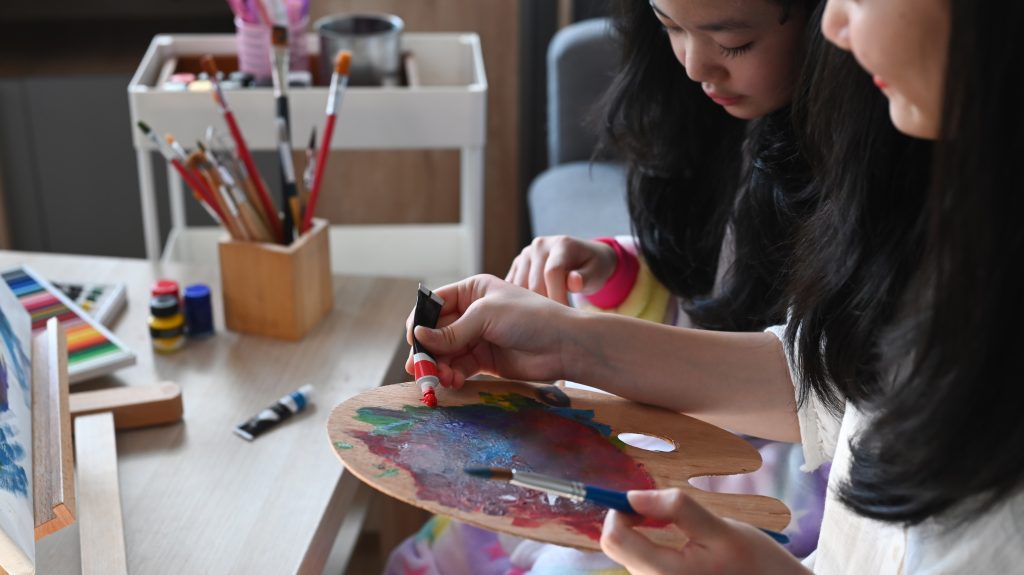
For many parents, art may look like a fun extra activity. A child paints, colours, cuts paper, plays with clay, and proudly shows the final artwork. At first glance, it may seem simple. However, art enrichment for kids is far more than a hobby or a way to keep children busy after school.
Art gives children a language before they can fully explain their thoughts in words. Through lines, colours, textures, movement, shapes, and stories, children learn how to express ideas, explore emotions, solve problems, make choices, and build confidence. In fact, for young children, art is often one of the most natural ways to think, feel, communicate, and understand the world.
That is why art enrichment should not be viewed only as “drawing class” or “painting class.” A good art enrichment programme can support cognitive development, social-emotional growth, fine motor coordination, language expansion, self-regulation, imagination, and creative confidence.
NAEYC explains that art is important for young children’s physical and cognitive skills as well as aesthetic awareness. It also highlights that open-ended art experiences can support creativity, thinking skills, enjoyment of art, and healthy development.
Therefore, when parents choose art enrichment for kids, the real question is not only, “Will my child make beautiful artwork?” A better question is, “Will this experience help my child explore, think, express, and grow?”
Understanding Creative Development in Children
Creative development is not only about becoming an artist. It is about learning how to imagine possibilities, make decisions, test ideas, adapt when something does not work, and express meaning in personal ways.
When a child mixes colours, they are experimenting. When they build a sculpture from recycled materials, they are planning and problem-solving. When they draw a family, animal, monster, or imaginary city, they are telling a story. When they say, “I want to try again,” they are developing persistence.
In other words, creativity is connected to many areas of child development. It supports the way children learn, communicate, regulate emotions, and interact with others.
Harvard’s Center on the Developing Child describes executive function and self-regulation skills as the brain’s “air traffic control system,” helping people manage information, make decisions, plan ahead, focus attention, and switch gears. These skills are not fully developed at birth; they grow through supportive environments where children live, learn, grow, and play.
Art enrichment can become one of those supportive environments. While creating art, children often need to focus, remember instructions, make choices, control hand movements, manage frustration, and revise ideas. As a result, the creative process can strengthen both imagination and self-management.
Art Enrichment for Kids and Whole-Child Growth
Art enrichment for kids works best when it supports the whole child, not only artistic technique. A strong programme gives children time to explore materials, understand basic art concepts, express emotions, collaborate with peers, and reflect on what they created.
This is especially important for preschool and early childhood learners. At this stage, children do not only need to produce “nice-looking” work. They need sensory experiences, language-rich conversations, open-ended exploration, and opportunities to feel capable.
The National Endowment for the Arts’ 2025 report on childhood arts education reviewed longitudinal data related to arts access, arts participation, and social-emotional, cognitive, and academic outcomes. The report notes that these datasets help examine how arts appear at critical points in children’s development and growth.
Although art alone should not be treated as a magic solution for every developmental need, research and early childhood practice both suggest that children benefit when arts are part of a rich learning environment.
Fine Motor Skills and Hand-Eye Coordination
One of the clearest benefits of art enrichment is fine motor development. Young children strengthen small hand muscles when they draw, paint, tear paper, squeeze glue, roll clay, hold crayons, cut with scissors, thread beads, or press materials onto a collage.
These movements are important because fine motor control supports many everyday skills, including writing, dressing, feeding, and handling classroom materials.
NAEYC notes that process art can support physical development because children’s small motor skills develop as they glue, draw, paint, and play with clay or homemade dough. These small motor skills are also important for future writing.
How Art Builds Physical Readiness
Children may strengthen fine motor skills through:
- Holding brushes, pencils, crayons, and markers
- Cutting, folding, tearing, and pasting paper
- Rolling, pinching, and shaping clay
- Tracing lines, curves, and shapes
- Using both hands together during art tasks
- Controlling pressure while drawing or colouring
- Practising hand-eye coordination through detailed work
However, parents should remember that children develop control gradually. A young child’s artwork does not need to look neat to be valuable. Scribbles, uneven lines, messy glue, and experimental marks are often signs of active learning.
Creative Thinking and Problem-Solving Skills
Art naturally invites children to make decisions. What colour should I use? How can I make this tower stand? What happens if I mix blue and yellow? How can I fix the paper if it tears? Should I add more details or stop here?
These questions may seem simple, but they help children practise flexible thinking. Instead of looking for only one correct answer, art encourages children to explore many possibilities.
This matters because real-life problem-solving often requires creativity. Children need to learn that mistakes can become new ideas, unexpected results can be interesting, and challenges can be solved in different ways.
Why Open-Ended Art Is Better for Thinking Skills
There is an important difference between process art and product art.
Product art usually has a fixed model. Every child follows the same instructions to produce the same final result. For example, all children may be asked to make an identical paper flower or animal.
Process art, on the other hand, gives children freedom to explore materials and make creative decisions. The final result may look different for every child, and that is the point.
NAEYC explains that process art gives children opportunities to explore materials, think, express themselves, and create, while product-focused art is more about following directions to make a predetermined end product. NAEYC also notes that product art offers fewer rich opportunities for cognitive, language, and social-emotional development compared with open-ended art.
Therefore, a strong art enrichment class should not only ask children to copy. It should invite them to wonder, experiment, choose, and explain.
Language Growth Through Art Conversations
Art can also support language development. When children create, they often want to talk about what they are making. They may describe colours, shapes, textures, characters, actions, stories, and feelings.
For example, a child may say, “This is my house,” “The dragon is hiding,” or “I used red because it is angry.” These small conversations build vocabulary, sentence structure, storytelling ability, and emotional language.
NAEYC highlights that art conversations can expand vocabulary when adults name materials, tools, and concepts such as scissors, collage, purple, wide, sticky, and smooth. Children may also talk about the ideas they express through art, which supports literacy development.
Vocabulary Children Can Learn Through Art
Art enrichment can naturally introduce words related to:
- Colours: bright, pale, dark, warm, cool
- Textures: rough, smooth, sticky, soft, bumpy
- Shapes: circle, triangle, curve, line, spiral
- Actions: mix, blend, press, fold, cut, tear
- Emotions: calm, excited, angry, proud, surprised
- Storytelling: character, place, beginning, problem, ending
In addition, art gives quieter children another way to communicate. A child who is not very verbal may still express ideas through images, symbols, and choices. With gentle prompting, adults can help the child connect visual expression with spoken language.
Emotional Expression and Self-Confidence
Children do not always have the words to explain what they feel. Art gives them a safe way to express emotions without needing perfect language. They can use strong colours, bold lines, soft shapes, repeated patterns, or imaginative scenes to show what is happening inside.
This does not mean every drawing should be overinterpreted. Parents should avoid assuming that one dark colour or unusual image means something negative. Instead, art should be seen as an invitation to listen.
A helpful question might be:
“Can you tell me about your picture?”
“What part do you like most?”
“How did you feel when you made this?”
“What is happening here?”
The University of Chicago Consortium on School Research reviewed more than 200 studies across six decades and found widespread belief among educators, parents, administrators, and students that arts education contributes to children’s and adolescents’ social-emotional development. The report also emphasizes that instructors should intentionally create safe spaces where students feel comfortable taking productive risks and processing challenges.
This is important because art can build confidence when children feel safe to try. However, it can also create pressure if adults overcorrect, compare, or demand perfection. The emotional value of art depends greatly on how the learning environment is designed.
Social Skills and Collaborative Learning
Although art may seem like an individual activity, it can also strengthen social skills. In a group art enrichment class, children may share materials, wait for a turn, discuss ideas, observe each other’s work, collaborate on a project, and appreciate different creative choices.
These moments help children practise respect, patience, empathy, and communication. For example, when one child says, “I made a rainbow castle,” another child may ask questions, offer ideas, or share their own story. This creates meaningful peer interaction.
The University of Chicago report describes arts education as offering opportunities for students to engage in action and reflection experiences, including encountering, tinkering, choosing, practising, contributing, describing, evaluating, connecting, envisioning, and integrating.
For young children, those experiences can be translated into simple classroom behaviours: trying something new, talking about what they made, listening to others, solving small conflicts, and learning that different people can create different answers.
Focus, Patience, and Self-Regulation
Art activities often require children to slow down. They may need to wait for paint to dry, try again after a mistake, control a brush carefully, complete several steps, or stay focused long enough to finish an idea.
This is why art enrichment can support self-regulation. Children learn to manage impulses and stay with a task, especially when the activity is interesting and meaningful.
NAEYC notes that art can support self-regulation and self-control as children focus, make choices, and feel successful. The ability to focus is also important for future school success.
Signs That Art Is Supporting Self-Regulation
Parents may notice that their child:
- Spends longer periods engaged in creative work
- Tries again when something does not turn out as expected
- Becomes calmer during drawing, painting, or clay play
- Waits for a turn to use shared materials
- Makes choices instead of asking adults to decide everything
- Shows pride after completing a self-directed project
Of course, not every child will sit quietly during art. Some children create with energy and movement. That is normal. The goal is not silent obedience. The goal is engaged attention, emotional safety, and gradual persistence.
Art Appreciation and Visual Thinking
Art enrichment is not only about making art. Children can also learn by looking at art. When children observe paintings, sculptures, patterns, photos, or cultural designs, they learn to notice details, compare ideas, describe what they see, and form opinions.
NAEYC states that art is important for young children’s physical and cognitive skills and aesthetic awareness, and also discusses the value of including art appreciation in early childhood settings.
Parents can encourage visual thinking with simple questions:
- What do you notice first?
- What colours do you see?
- What do you think is happening?
- How does this artwork make you feel?
- What would you add if you were the artist?
These questions help children slow down, observe carefully, and express thoughts. They also teach children that art is not only about right or wrong answers. It is about seeing, feeling, wondering, and interpreting.
Art, STEAM Learning, and Early Academic Readiness
Art also connects naturally with STEAM learning: science, technology, engineering, arts, and mathematics. When children build with cardboard, create patterns, mix colours, design structures, explore symmetry, or draw maps, they are developing early thinking skills that connect to multiple subjects.
For example:
- Mixing colours introduces early science concepts.
- Creating patterns supports mathematical thinking.
- Building 3D forms supports spatial reasoning.
- Drawing stories supports literacy.
- Designing a structure supports engineering habits.
- Discussing artwork supports language and observation.
NAEYC’s creative arts resources include examples of art connecting with vocabulary, STEM thinking, engineering challenges, storytelling, and make-believe play, showing how creative arts can integrate with broader early learning. (NAEYC)
This is why art enrichment should not be seen as separate from “serious learning.” When planned well, art becomes a bridge between creativity, communication, thinking, and academic readiness.
What Makes a Good Art Enrichment Class?
Not all art classes offer the same developmental value. Some classes focus heavily on copying, neat results, and adult approval. Others focus on exploration, technique, creativity, and child-led expression.
A good art enrichment class should balance guidance and freedom. Children still benefit from learning how to use tools, understand materials, and practise techniques. However, they also need space to make choices and create original work.
Qualities Parents Should Look For
A strong art enrichment programme may include:
- Open-ended creative activities
- Age-appropriate materials and tools
- Teachers who guide without overcorrecting
- Opportunities for children to explain their work
- A balance of technique and imagination
- Process-focused learning, not only final products
- Safe, welcoming, and non-judgmental feedback
- Activities that support fine motor, language, and emotional growth
- Encouragement for each child’s unique style
Parents can also observe how teachers respond to mistakes. In a healthy creative environment, mistakes are not treated as failure. They become part of exploration.
How Parents Can Support Art Learning at Home
Parents do not need a professional studio to support creativity. A small art corner with simple materials can be enough.
Useful materials may include:
- Crayons, washable markers, and pencils
- Plain paper, recycled paper, and cardboard
- Child-safe scissors and glue
- Clay or playdough
- Fabric scraps, leaves, buttons, or recycled materials
- Watercolour or washable paint
- Stickers, stamps, or textured materials
However, the most important material is not paint or paper. It is the adult’s attitude. Children create more freely when adults show interest without controlling the result.
Better Questions Than “What Is It?”
Sometimes, asking “What is it?” may make children feel their work must represent something recognizable. Instead, parents can ask:
- “Can you tell me about this?”
- “How did you make this part?”
- “What did you enjoy most?”
- “What colours did you choose?”
- “What would you like to try next?”
These questions encourage reflection and language without judgment.
Common Mistakes Parents Should Avoid
Even well-meaning parents can accidentally reduce the developmental value of art. Here are a few habits to watch for.
Over-Fixing the Child’s Artwork
When adults constantly adjust the child’s work, children may learn that their own ideas are not good enough. Instead, let the child’s artwork remain theirs.
Comparing Children’s Art
Statements such as “Look, your friend’s drawing is neater” can damage confidence. Each child has a different developmental stage, style, and creative process.
Focusing Only on the Final Product
A beautiful final artwork is nice, but the real learning happens during the process. Ask about choices, effort, discovery, and ideas.
Giving Too Many Instructions
Too many instructions can turn creative work into compliance. Guidance is helpful, but children also need room to explore.
Art Helps Children Grow From the Inside Out
Art enrichment for kids is more than a creative pastime. It supports how children think, feel, move, communicate, focus, imagine, and connect with others. Through drawing, painting, sculpting, cutting, building, observing, and storytelling, children practise skills that support both early learning and lifelong development.
Most importantly, art gives children ownership. It allows them to make choices, take creative risks, express emotions, solve problems, and feel proud of something they created themselves.
For parents, the goal is not to raise a perfect young artist. The goal is to give children meaningful opportunities to explore who they are and how they see the world. When art enrichment is playful, thoughtful, and developmentally appropriate, it can help children grow with confidence, curiosity, and joy.